
Your labs came back “normal.” So why do you still feel like this?
Reference ranges tell you if you’re sick. We look at whether you’re actually well. There’s a big gap between the two, and it’s where most people get stuck.
The signs are everywhere.
You already know something’s off.
Yet waking up exhausted
But 3pm feels like hitting a wall
Now it takes days
You need it just to feel normal
It's your new baseline
Standard bloodwork measures survival—the bare minimum. But you don’t want to survive. You want to thrive.
Normal isn't optimal.
The critical difference.
Surviving
What keeps you functional
Vitamin D
ng/mL
Within normal range
Testosterone
ng/dL
Within normal range
Cortisol AM
μg/dL
Within normal range
Free T3
pg/mL
Within normal range
“Your labs look fine. There’s nothing wrong.”
Thriving
What drives peak performance
Vitamin D
ng/mL
Optimized for performance
Testosterone
ng/dL
Optimized for performance
Cortisol AM
μg/dL
Optimized for performance
Free T3
pg/mL
Optimized for performance
“This is where you perform at your best.”
The gap between these two states? That’s where your potential lives.
Your body is a system.
Everything connects. When cortisol spikes, sleep suffers. When sleep suffers, testosterone drops. When testosterone drops, recovery slows. It cascades.
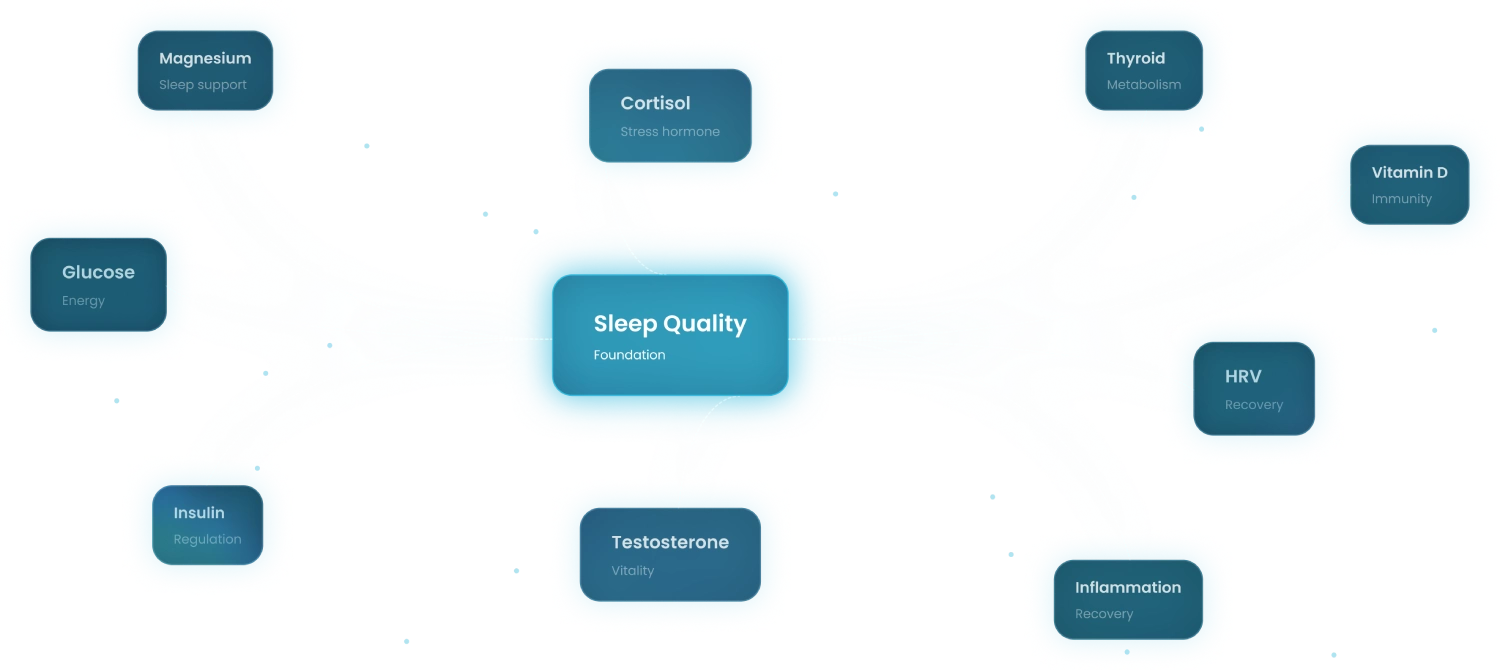
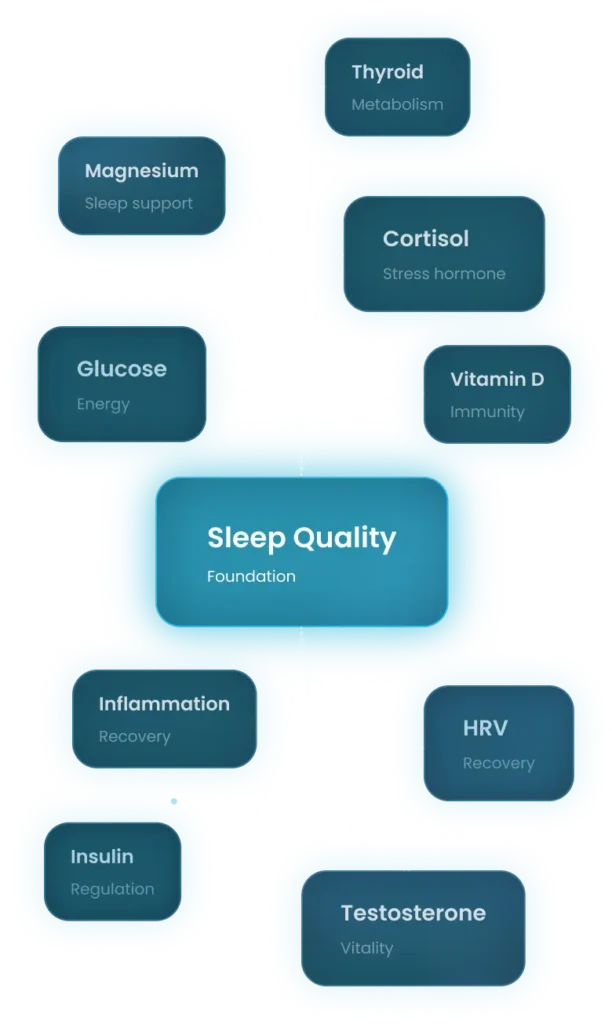
Optimizing one marker in isolation is guesswork. Understanding the system is science.
100+ biomarkers. One complete picture.
Comprehensive biomarker analysis to optimize your health and performance.
Cognitive & Mental Performance
- Neurotransmitter precursors
- Brain-derived neurotrophic factor (BDNF)
- Inflammatory markers affecting cognition
- Oxidative stress indicators
- B-vitamin status (B6, B12, Folate)
- Homocysteine levels
Hormone Balance
- Total & Free Testosterone
- Estradiol
- DHEA-S
- Thyroid panel (TSH, T3, T4)
- Sex Hormone Binding Globulin
Metabolic Health
- Fasting glucose & insulin
- HbA1c
- Complete lipid panel
- Liver enzymes
- Kidney function
Recovery & Stress
- Cortisol (AM & PM)
- C-Reactive Protein
- Creatine Kinase
- Magnesium
- Heart Rate Variability markers
Nutrient Status
- Vitamin D (25-OH)
- Iron panel (Ferritin, TIBC)
- Omega-3 Index
- Electrolytes
- Zinc & Copper
Plus: Personalized Treatment Areas based on your intake
Additional markers for athletes, executives under chronic stress, or those with specific health goals are included when relevant.
Simple process. Profound results.
How it works.

Initial Consultation
We discuss your goals, symptoms, and health history to customize your panel

Blood Draw
Visit any Quest or LabCorp location, or request an at-home phlebotomist

Deep Analysis
Results reviewed by our clinical team and analyzed for patterns
and optimization opportunities

Your Protocol
Personalized plan with specific interventions, tracking, and follow-up milestones
Typical turnaround: 7-10 days from blood draw to protocol delivery

Data becomes insight
From numbers to action.
"Why do I crash every afternoon?"
Peaks at 2pm instead of morning
Dysregulated stress response
Peaks at 2pm instead of morning
Elevated at 18 μIU/mL
Poor glucose handling
Elevated at 18 μIU/mL
Low-normal at 1.9 mg/dL
Insufficient for stress demands
Low-normal at 1.9 mg/dL
- Cognitive Score
vs. last month
- test
- test
- test
- test
Updated today at 9:27 AM
The protocol:
- → Adjust meal timing to stabilize glucose
- → Supplement magnesium glycinate (400mg, evening)
- → Morning light exposure to reset cortisol rhythm
- → Retest in 6 weeks
FAQ
What does a comprehensive blood panel test for?
Our standard panel measures 66 biomarkers that drive how you feel day to day, including sex hormones, thyroid function, metabolic and blood sugar markers, cholesterol and lipids, key vitamins and minerals, inflammation, and liver and kidney function. Expanded testing of 100+ markers is available when your provider recommends it.
Why does Relive Health start with blood work?
Because symptoms alone don’t tell the full story. Blood work shows exactly where your levels sit, lets your provider prescribe safely, and gives us a baseline to measure your progress against.
Do I need to fast before my blood draw?
In most cases, yes. Plan on 8 to 12 hours without food, with water allowed. Your clinic will confirm the exact instructions when you book.
How long does it take to get blood work results?
Results are usually back within a few business days. Your provider reviews them with you in a follow-up so you understand what each marker means and what comes next.
How often should I retest my blood work?
It depends on your treatment plan. Most clients on hormone or weight loss programs retest every few months at first, then less often once their levels stabilize. Your provider sets the schedule.
Can I use blood work from my primary care doctor?
Sometimes. If your labs are recent and include the markers we need, your provider may be able to use them. Most clients still need a full baseline panel because standard physicals don’t cover everything we look at.
What happens after my results come back?
You meet with your provider to review every marker, discuss what’s optimal versus simply in range, and build a plan. That plan may include hormone therapy, peptides, weight loss support, supplements, or lifestyle changes.
Is the blood draw done in the clinic?
Yes. Blood is drawn on site at your Relive Health location by trained clinical staff, so you don’t need a separate lab appointment.
What clients say.
Success stories, as told by you.
You deserve more than "normal”.
If your labs keep coming back fine but you still feel off, the gap between reference range and optimal range might be exactly where your answers are.
- Physician reviewed
- Results in 48 hours
- 4.9 average rating